Loan Programs · Head to Head
DSCR vs. conventional: who's actually getting qualified, you or the property?
Conventional looks at your income and tax returns. DSCR looks at whether the rent covers the mortgage. That changes who this fits.
Written by the East Coast Mortgage team
Editorial review: East Coast Mortgage, NMLS #2354674 · Last reviewed
Buying an investment property, you generally have two paths: qualify the standard way, on your personal income and tax returns through a conventional loan, or qualify using DSCR, the debt service coverage ratio, which looks at whether the property's own rental income covers its mortgage payment instead.
This matters most for investors whose tax returns don't tell the full story, self-employed borrowers, people scaling a rental portfolio, or anyone whose legitimate write-offs make their real income look smaller on paper than it actually is.
| Compare | DSCR | Conventional |
|---|---|---|
| What qualifies the loan | The property's rental income vs. its mortgage payment | Your personal income, tax returns, and debt-to-income ratio |
| Documentation | Minimal personal income paperwork | Full income verification and tax returns |
| Down payment and rate | Typically higher, reflecting the alternative qualification | Standard investment-property terms, usually the better pricing if you qualify on paper |
| Underwriting | Often faster, fewer documents to review | Standard timeline with full income verification |
| Best for | Investors whose tax returns don't reflect their real financial strength, or who are scaling a portfolio | Investors with straightforward, well-documented personal income |
General program guidelines only. Your actual terms depend on the lender, your credit, and the property. Not a commitment to lend.
So which one is it?
If your personal income and tax returns are straightforward and well-documented, conventional financing for an investment property is usually simpler and can price better. If you're self-employed, already own multiple properties, or your write-offs make your real income look weaker on paper than it is, DSCR qualifies the deal on the property itself instead of fighting your tax return, and it tends to scale more easily as a portfolio grows.
Read the full breakdown of each: DSCR Investment Property Loans and Conventional.
Common questions
Do I need to show my personal income or tax returns for a DSCR loan?
Typically no, a DSCR loan focuses on whether the property's rental income covers its mortgage payment, not your personal pay stubs or tax returns.
Can I use a DSCR loan for my primary home?
No, DSCR loans are built for investment properties. A primary residence would use a conventional, FHA, VA, or similar owner-occupied program instead.
Can DSCR loans help me grow a rental portfolio?
Yes, that's one of the most common uses. Since DSCR loans qualify on the property's income rather than yours, they scale more easily than trying to qualify property after property on your personal tax returns.
Sources
- Fannie Mae: Selling Guide B2-1.1-01, Occupancy Types
- CFPB: Conventional loans
General information, not advice for your specific situation. Program rules come from the agencies above and from each lender, and they change. A licensed loan officer confirms what applies to you.
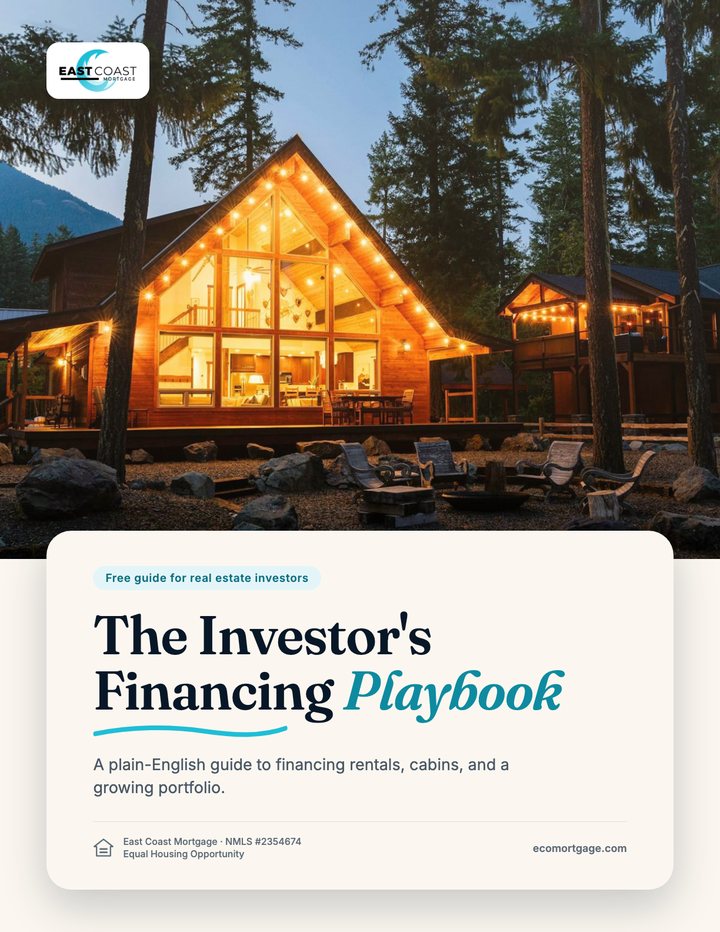
Free guide · real estate investors
The Investor's Financing Playbook
DSCR, cash-out, and how to finance a growing rental portfolio. Instant download, no cost.
Ready when you are
Not sure which one fits? Let's actually run your numbers.
A real, licensed loan officer checks both against your credit, savings, and goals. No obligation, no credit pull to start.
NMLS #2354674 · Equal Housing Opportunity · Not a commitment to lend